612 vs. 499: A Wake-Up Call for Swiss Parents
Our children are still above average. That is exactly the problem.
1. Two numbers
612. The average PISA 2025 maths score of 15-year-olds in Beijing (北京), Shanghai (上海), Jiangsu (江苏) and Zhejiang (浙江): the highest in the world.
499. Switzerland's score: the lowest Swiss result ever recorded, in maths and in reading.
The OECD counts 22 points as just over one year of learning. The gap is 113 points. That is roughly five years of school.
PISA 2025, mean scores of 15-year-olds (sources: OECD data via Singapore MOE, Südostschweiz):
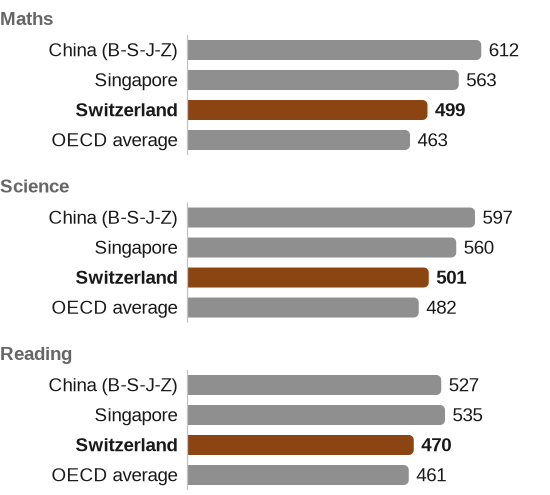
China's result covers only these four regions, not the whole country. But our decline is homemade: since 2015, Swiss maths fell from 521 to 499 and reading from 492 to 470.
PISA 2015 to 2025, Switzerland's mean scores (sources: SERI, in French; swissinfo):
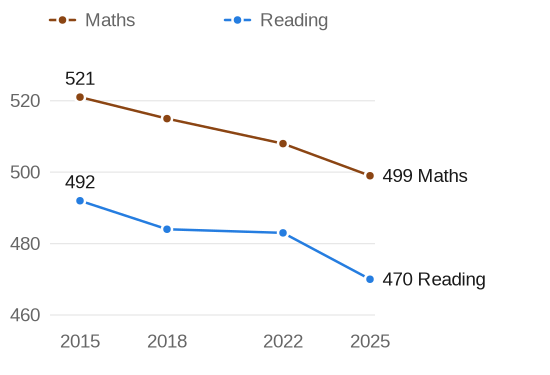
Today, 28.8% of Swiss 15-year-olds miss the minimum level in reading, and 23.2% in maths.
2. Meanwhile, in China
On 7 June 2026, the gaokao (高考), China's university entrance exam, began for 12.9 million registered students. That is more people than Switzerland's entire population of 9.1 million.
For a closer look at the gaokao and what it demands of students, watch "The Hardest Test in China" (PolyMatter, 12 minutes):
- The exam town. Maotanchang (毛坦厂), Anhui (安徽), has 4,000 permanent residents, yet more than 10,000 students come to cram at its high school. Many parents rent flats in town to live and cook for them, a practice called peidu (陪读).
- The IV-drip classroom. Students at Xiaogan No. 1 High School (孝感一中) in Hubei (湖北) studied hooked up to amino-acid drips, believing they would give them energy for the gaokao.
- "Chicken-blood" parents. Beijing's jiwa (鸡娃) parents schedule their children's days in 15-minute increments; some buy second homes next to the best schools.
- AI goes dark. During the 2025 gaokao, Qwen (通义千问), Doubao (豆包), Yuanbao (元宝), Kimi and DeepSeek (深度求索) blocked exam-related features. In 2026 they did it again.
- The hours. In PISA 2015, students in the Chinese provinces tested spent at least 54 hours a week learning; Swiss students, fewer than 40.
- The result. At the 2026 International Mathematical Olympiad in Shanghai, all six Chinese contestants won gold, three with perfect scores. The US came second.
The system has its costs. In 2021, Beijing's "double reduction" (双减) policy forced core-subject tutoring firms to become non-profits. Youth unemployment reached 18.9% in August 2026, and many young graduates are "lying flat" (躺平). We must not copy the drips. We must copy the seriousness.
3. From classroom to laboratory
- China now contributes about twice as much as the US to the world's top science journals (Nature Index 2026: 52,735 vs. 26,006).
- Nine of the world's ten leading research institutions are Chinese, and Harvard has fallen to third. The Chinese Academy of Sciences (中国科学院) is first.
- Zhejiang University (浙江大学) has overtaken Harvard in research output; seven of the world's top ten universities are Chinese (Leiden Ranking 2025).
- China publishes the most high-impact research in 69 of 74 critical technologies, and has just overtaken the US in language AI and genetic engineering.
- In 2024, China's R&D spending moved ahead of the United States.
4. "Science is dominated by the Chinese, on both sides of the Pacific"
In AI and the hard sciences, the numbers bear this out.
- 57% of the world's top AI researchers did their first degree in China. Only 13% studied in the US.
- Inside American labs, 38% of top AI researchers come from China and 37% from the US (2022).
- China is the largest source of foreign PhDs in America: 6,756 in 2024 alone. Students on temporary visas earn 61% of US doctorates in computer science.
- And now they are going home. 69% of China-educated top AI researchers stay in China, up from 57% in 2022. Returning scientists rose from 31 in 2004 to 1,409 in 2022. Harvard statistician Liu Jun (刘军) is one of them.
5. The proof: Chinese-American families
Take away the Chinese school system, and the results remain. The engine is the family.
- 58% of Chinese Americans hold a university degree. Among those born in the US, 70% do, against 33% of all Americans.
- Their parents often arrive well educated: Asian immigrants are more highly educated than average Americans. Yet that is not what sets the children apart. Asian-American pupils outperform white classmates mainly through greater academic effort, not higher tested ability or family background.
- That effort comes from home: what immigrant parents pass on is not their degrees but the belief that effort leads to success.
- In 2024, Asian-American teenagers led the US team to victory at the International Mathematical Olympiad.
No ministry produced these results. Parents did.
6. Switzerland's blind spot
Switzerland is the world's most innovative economy for the 16th year running. But our science runs on imported brains: 57% of new doctoral students are foreigners, and about 70% of ETH Zurich's professors are not Swiss.
That model works only while the world's best want to come. More and more of them stay home.
7. Questions every Swiss parent should ask
- If almost three in ten of our 15-year-olds cannot read at a basic level, who will invent the next Swiss medicine?
- When the best graduates of Zhejiang University and Tsinghua (清华大学) no longer need ETH, who will fill its labs?
- If an engineer in Shenzhen (深圳) can do our children's future jobs better and cheaper, what will our children sell to the world?
- In 2050, will our children set the standards, or apply abroad for the good jobs?
- When they ask what we did once the warning signs were plain, what will we answer?
8. Seven commitments for Swiss parents
- Read every day, on paper. The OECD links falling reading scores to more screen time and less reading for pleasure.
- Keep phones out of homework and bedrooms. A third of Swiss teenagers spend over three hours a day on social media on weekdays, and results fall sharply when devices are used for fun in class.
- Do maths every day. Fifteen minutes, no excuses. Never say "I was never good at maths either."
- Aim for the best, not the average. Switzerland should measure itself against the best, not against the OECD mean.
- Praise effort, not talent. Celebrate a hard-won grade like a goal on the football pitch.
- Let them compete. Sign them up for the Swiss Science Olympiad or Schweizer Jugend forscht.
- Honour both Swiss roads. Two-thirds of young Swiss go through vocational education. Ambition belongs in the workshop as much as in the Gymnasium.
And protect what high-pressure systems lose: sleep, play, friendship, faith and family.
Wake up
In the Gospel, the servant who buried his talent to keep it safe was called "wicked" and "lazy" (Matthew 25:26). Switzerland has been given many talents. Burying them in comfort would be the riskiest choice of all.
Share this with one Christian parent who needs to read it today.


